Search

Showing posts with label US. Show all posts

Friday, 9 January 2009

No copyright for prisoner

The IPKat was intrigued to read on Wired about a US employee's copyright case with a difference.

James Walton prepared a number of calendars in the course of his employment. One of these he copyrighted in 2001. He subsequently sued his 'employer' after the 'employer' sold them to the US Government's General Services Agency, which distributed them to a number of federal agencies.

The difference is that Mr Walton is a convicted bank robber, and the 'employer' in question was Federal Prison Industries Inc., which employs prisoners in the federal penitentiary where Mr Walton is serving a 17 year sentence.

US copyright law prevents the enforcement of copyright against the US Government by those who created works in "employment or service" of the United States. The court found that it did not need to decide whether Walton was an 'employee' of the US because it was clear that, while in prison, he was acting in the 'service' of the US.

Service had to be defined differently from employment (though the two terms are related). According to the court:

Working for someone and under his direction may constitute being in that person’s “service” even though the relationship does not amount to the typical common-law master-servant relationship that the term “employment” ordinarily describes. Walton’s preparation of the calendar was done “while in the service of the United States.” He developed and made the calendar at the direction of and with computers provided by the United States, and was supervised by United States employees in that work. He performed the work at a government facility, and the government paid him modest compensation for his efforts.


The IPKat reckons that this is a common-sense decision, but one that arguably stretches the words of the legislation. He wonders though if it wouldn't have been easier to treat Walton as an employee. After all, he was doing a job and being paid.

Thursday, 8 January 2009

Able or eligible?

Here's a chance for some of the IPKat's most knowledgeable patent people to come to his aid. In the context of last year's controversial US patent decision in Re Bilski (noted IP Finance and lots of other places too), blog team member Jeremy has been confronted with the terminology "patent eligible".  He thinks he knows what "patentable" means, which leaves him wondering whether patent eligible is
* a long-winded synonym for patentable; 
* a subtly different concept or 
* anything else.
Can any reader please advise?

Monday, 22 December 2008

Cricket, lovely cricket

You've got to feel a bit sorry for Sir Allen Stanford, the Texan-Antiguan patron of West Indian cricket. Last week's Daily Telegraph reported that Sir Allen is being sued by Stanford University for trade mark infringement. The university is concerned that Sir Allen's attempts at trade mark registration involve “intentional and bad faith conduct". The claim also seems to rely on likelihood of confusion. It seems that the university is conscious that Sir Allen wants to introduce cricket to the US and may affect the university's merchandising activities.

The IPKat isn't impressed. How can it be bad faith to use your own name? Moreover, he doubts that there is that much advantage for Sir Allen in associating cricket with a US university - our transatlantic cousins are gifted in many ways, but generally not in the relationship between willow and leather.

Friday, 12 December 2008

Victory, defeat and unenforceable patents

Here, via the 24IP Law Group, comes a news flash entitled "Enforcement of IP Rights relevant to industry standards". Discussing the significance of the US ruling in Qualcomm Inc v Broadcom Corp at the beginning of this month it reads, in relevant part:

"Patents relevant to the use of a standard may be unenforceable if the patent holder withheld information during the standards development process, the Appeals Court in the United States (the US Court of Appeals for the Federal Circuit) concluded recently.

The case related to the H.264 Standard for video compression developed jointly by the International Telecommunications Union (ITU) and the Moving Picture Experts Group (MPEG) of the International Standards Organisation (ISO) and the International Electrotechnical Commission (IEC). The US company Qualcomm had participated in the standards development process, but had not submitted any technical proposals for the development of the standard. Qualcomm then tried to enforce two patents against another US company, Broadcom, for infringement of the patent and payment of royalties.

The District (lower) Court found the patents valid, but not infringed. Moreover, in a significant judgment, the lower court held that the patents were unenforceable since Qualcomm had engaged in “inequitable conduct”. The court asserted that, by participating in the standards development process, Qualcomm had agreed to inform the other members of the standards setting organisation of relevant intellectual property rights (such as patents). Qualcomm had failed to do this. Indeed the evidence showed that Qualcomm had engaged in a process of “disguising” the relevance of the patents to the standard. Qualcomm asserted their patent rights only after grant of the patents and when the standard had been agreed. Qualcomm in its defence argued that only participants submitting technical disclosures were required under the rules to notify the other participants of the relevance of standards.

Qualcomm appealed the judgment of the lower court.

The Appeals Court concluded that the requirement to disclose relevant patents applied to any participant in the standards development process, as this obligation was contained in the relevant provisions of the ITU, ISO and IEC. All participants were obliged to inform the standards-setting organisation of any patents that “reasonably might be necessary” to practise – in this case - the H.264 standard. The Appeals Court ruled that, because of the failure to make the disclosure, an appropriate remedy would be to rule the patents unenforceable against any H.264-compliant products. It rejected arguments to make the patents per se unenforceable.

The scope of the decision is limited to the United States, but it has implications to any participant in standards setting discussions worldwide. The Court has clearly stated that any participant in a standard-setting organisation which withholds information about relevant patents which might be necessary to practice the standard will not be able to enforce those patents in the United States.

The Court has, however, given no guidance on whether the disclosed patents must be licensed and under what terms a licence will be granted. This remains a matter of the standards setting organisation to decide. Most organisations require that licences be granted on “fair, reasonable and non-discriminatory terms” (FRAND). The question before several courts at present is the meaning of FRAND terms".

The IPKat is always saddened when all that effort that goes in standards-setting leads to litigation. In theory it should be friction-free and competition-friendly, but technical misunderstandings and misjudgments, drafting imperfections, impatience and opportunism all play their part in ensuring that the gulf between the ideal and the real remains as wide as ever. Merpel says, you'd think that Open Source licensing would provide more litigation and patent standards less -- but it's very much the other way round. This looks like a good topic for a PHD thesis or two.

How others see it:
Qualcomm wins here
Qualcomm loses here

Monday, 8 December 2008

DMCA review and iPhones; Chinese font copyright case


Mobile and iPhone locking v. the DRM


Every three years the US Copyright Office reviews whether there is a need to provide further exceptions to the digital rights management provisions of the Digital Millenium Copyright Act. This process will next take place in 2009 and cellular news reports that the US-based Electronic Frontier Foundation has filed a request for an exemption to cover ‘jailbreaking’. Before law and order fans start tut tutting, ‘jailbreaking’ is the process of unlocking iPhones so that they will run software that does not originate from Apple. The EFF has made a similar application to continue an order which allows those who own mobile phones to unlock them so that they work on other networks.

The IPKat thinks that this is quite right and sounds like the sort of practice that would be stopped by competition law if copyright law doesn’t get there first. However, if you make is harder for service providers to ‘hook’ customers by giving them cheap or subsidised handsets, it is likely that the providers will recoup their profits elsewhere – probably by making the handsets reflect something more like their true market value.

EFF press release and documents available here.

Chinese font copyright case

The IPKat has learnt from People’s Daily Online that Founder Electronics has sued Procter & Gamble (Guangzhou) for copyright infringement. The claim is that P & G infringed Founder’s copyright in its fonts by using Founder’s “Qian style” and "Cartoon style” fonts on 55 P & G products (including the one pictured) and publicity material. The case is before the People’s Court in Beijing Haidian District.

The IPKat reckons that this is one to watch. It’s rare that font copyright cases come before the courts.

Tuesday, 2 December 2008

Save the Bolton Six; Obama chooses Creative Commons

Heigh ho, heigh ho, it's off to court we go

Bad news from Bolton. The Bolton News reports that the six of seven dwarves in Bolton’s festive production of Snow White will not be named Doc, Dopey, Sleepy, Grumpy, Happy and Bashful after Disney asserted its copyright in the names. Although the story of Snow White was first ‘codified’ in the 19th Century by the Brothers Grimm, the dwarves were first given their names in Disney’s 1937 film. The show will go on though, and the Bolton Six will be known as Goody, Loopy, Lazy, Growler, Noisy and Shabby. Sneezy’s name, for reasons that the story doesn’t elaborate on, will retain his moniker.

The IPKat is puzzled. Since when were names protected by copyright? At best characters may perhaps have some protection (but probably not) and from the new names, it looks like the characters may be broadly the same.


Obama and Creative Commons

CNET reports that the website of US President Elect Barak Obama is now licenced under a Creative Commons Licence. The version chosen and displayed on change.gov allows users to copy, distribute, display, and perform the work, and to make derrivative works, as long as the source is attributed.

The IPKat cautions that this may not be a reliable indicator of Obama’s overall copyright policy. After all, politicians want their official ‘message’ to be distributed as widely as possible. This may not be true of their views on their other works, and the works of others.

Friday, 24 October 2008

DoJ bans biker trade mark


The IPKat has learned from the Associated Press that the US Department of Justice has effectively seized control of the trade mark of the Mongols motorcycle gang, a picture of a Mongolian warrior wearing sunglasses. The gang appears to have been engaged in violent crime, and at the same time as the injunction banning the use of the trade mark, 79 gang members were indicted. Although the injunction banning the logo originally cracked down on distribution or sale of the logo, it now states that gang members "shall surrender for seizure all products, clothing, vehicles, motorcycles ... or other materials bearing the Mongols trademark, upon presentation of a copy of this order."

The Office of the US Attorney has said that it is drafting a protocol for such seizures, but others have cricised the moves as interfering with free speech.

The IPKat is relatively sanguine about this. He agrees that free speech is a serious consideration where a trade mark offends others. However, this mark seems more than offensive – it seems like it could incite wearers and others to commit violence. Surely this outweighs free speech? The Kat also notes that such moves might be unknown in the US, but in the UK, wearing clothing bearing the insignia of a banned group can result in an offence against anti-terrorist legislation.

Monday, 22 September 2008

RIAA sues dowload defence lawyer

The IPKat has learnt from Computer World that RIAA (the Recording Industry Association of America) has brought legal proceedings against Ray Beckerman, a New York based lawyer who had defended a number of individuals who have been at the receiving end of RIAA downloading lawsuits.
Ray Beckerman (left)
It appears that the claims against Mr Beckerman are part of a motion to dismiss a case, brought by RIAA, against a lady who claims not to know how to operate a computer. RIAA is arguing that its ability to uncover evidence was impaired by Beckerman and his client and that various ‘frivolous’ motions were filed.

RIAA has also objected to the fact that Mr Beckerman posts details on cases on his blog, ‘Recording Industry vs The People’, arguing that this ‘demeans the integrity of these judicial proceedings and warrants this imposition of sanctions’.

The IPKat doesn’t like the sound of this too much. He is particularly disturbed by the idea that an attorney shouldn’t be able to publicise details of his cases – what about free speech? After all, RIAA tends to be vocal about the lawsuits it is bringing in order for those actions to have the deterrent effect that it desires.

Thursday, 21 August 2008

Gold in China; Mother wins round 1 of YouTube dancing baby case

Another British success in China

No, it's not the Olympics, but rather the news in the Scotsman that the Scotch Whisky Association has succeeded in gaining geographical indication protection in China for the term 'Scotch Whisky'. China imports 17 million bottles of Scotch a year.

The IPKat is too busy celebrating this Scottish triumph in traditional fashion to comment.


Fair use take-down victory

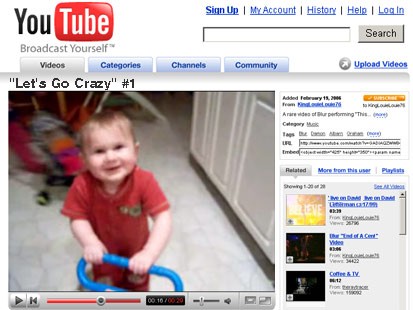
The LA Times reports that Stephanie Lenz, a mother who posted a clip of her baby dancing to the artist formerly known as the artist formerly known as Prince's song, 'Let's Go Crazy' has won the first stage of her battle against Universal Music (see earlier IPKat post here). Ms Lenz's clip was removed from YouTube after the site received a takedown notice under the Digital Millennium Copyright Act from Universal, the holder of the copyright in the song. The clip was reinstated after a month, but Lenz sued under the DMCA, pointing to the requirement therein that copyright owners can only demand the taking down of a work if they have "a good faith belief that use of the material in the manner complained of is not authorized by the copyright owner, its agent, or the law."

Universal argued that copyright holders, in making this assessment, did not need to take into account whether the use made by the subject of the notice was fair use, since fair use is a defence, rather than a legal right. Not so, according to Judge Jeremy Fogel, who states:
"Even if Universal is correct that fair use only excuses infringement, the fact remains that fair use is a lawful use of a copyright. Accordingly, in order for a copyright owner to proceed under the DMCA with “a good-faith belief that use of the material in the manner complained of is not authorized by the copyright owner, its agent or the law,” the owner must evaluate whether the material makes fair use of the copyright. 17 U.S.C. § 512(c)(3)(A)(v)."
However, he went on the conclude that Lenz was unlikely to win the case at full trial as she would need to show subjective bad faith on the part of Universal, i.e. that when it issued the takedown notice, it knew it was making a groundless threat of infringement.

The LA Times observes that the need to evaluate fair use will make it difficult for copyright owners to use automated 'bots to root out works which borrow from copyright works and issue take down notices ('bots can't evaluate whether use is fair).

The IPKat reckons that this is a good decision. On the whole, copyright owners are likely to be in a better position to evaluate fair use than individuals who post materials, and hosting sites, if forced to evaluate fair use may take a risk-averse strategy that would prevent them from allowing many socially useful works. The IPKat reckons that unless copyright owners are forced to evaluate fair use, many works which constitute fair uses will just disappear if made the subject of take-down notices since only exceptional individuals like Ms Lenz will persevere in getting their work reinstated.

Thursday, 14 August 2008

Open source licence enforced under copyright law

The IPKat has a bit of a thing for US copyright law today. He has learnt from that the Federal Circuit Court of Appeals has held in Jacobsen v Katzer that an open source copyright licence can be enforced under copyright law, rather than merely under contract law. The claimant made software available for decoders for model railways from his website. The defendant used and modified the software but failed to comply with the licence in the following ways:

His software did not include

(1) the authors’ names,

(2) the claimant’s copyright notices,

(3) references to the COPYING file,

(4) an identification of the claimant as the original source of the definition files, and

(5) a description of how the files or computer code had been changed from the original source code.

The District Court held that this was a breach of contract, which did not give rise to a right to an injunction.

The CAFC recognised:

The lack of money changing hands in open source licensing should not be presumed to mean that there is no economic consideration, however. There are substantial benefits, including economic benefits, to the creation and distribution of copyrighted works under public licenses that range far beyond traditional license royalties.

The terms of the licence were classed as ‘conditions’ on the scope of the licence rather than ‘covenants’, which meant they were governed by copyright law, and enforceable as such. On its literal wording, the licence referred to ‘conditions’. Moreover, the fact that money didn’t change hands in return for being allowed to use the copyright work didn’t mean that the restrictions weren’t copyright restrictions. According to the court:

Copyright licenses are designed to support the right to exclude; money damages alone do not support or enforce that right. The choice to exact consideration in the form of compliance with the open source requirements of disclosure and explanation of changes, rather than as a dollar-denominated fee, is entitled to no less legal recognition. Indeed, because a calculation of damages is inherently speculative, these types of license restrictions might well be rendered meaningless absent the ability to enforce through injunctive relief.

The IPKat welcomes this case, as it should make authors more likely to make their work available to the public if they know that it will be protected copyright, and not just contract. He notes that the same distinction may be relevant in the UK, where there are also differences in the remedies available between the two causes of action.

Wednesday, 16 July 2008

Good news for Sir Cliff and eBay

Commission adopts extended performers rights

The European Commission has today adopted a proposal for 'extending the term of protection for recorded performances and the record itself from 50 to 95 years'. [Press release here]. This is said to benefit both performers and record companies. This is designed to 'bridge the income gap' when the sound recordings of performances made in an artist's twenties expires when they reach their seventies.

At the same time, the Commission appears to be tinkering with more general copyright protection for musical works. According to the press release:

In addition, when it concerns a musical composition, which contains the contributions of several authors, the Commission proposes a uniform way of calculating the term of protection. Music is overwhelmingly co-written. For example, in an opera, there are often different authors to the music and to the lyrics. Moreover, in musical genres such as jazz, rock and pop music, the creative process is often collaborative in nature. According to the proposed rule the term of protection of a musical composition shall expire 70 years after the death of the last surviving author, be it the author of the lyrics or the composer of the music.
The IPKat isn't entirely sure if he has read this correctly, but it looks like the Commission is proposing to lump together musical and literary authorial works set to music and grant a single term. If this is correct, this goes against our traditional notions of how such works are viewed, and the same logic (of treating both works as one) could conceivably apply elsewhere, such as in judging infringement.

The Commission is also launching a Green Paper on on the long-term future of copyright policy in the knowledge intensive areas. This will cover scientific publishing, the digital preservation of Europe's cultural heritage, orphan works, consumer access to protected works and the special needs for the disabled to participate in the information society.

The IPKat notes that this is another example of IP rights being expanded to the max. For one thing, record companies appear to be getting some sort of slice of the pie. The 95 year term is generous (though the Kat notes that this would be an increasingly common lifespan). He remains unconvinced that recording artists have a right to be remunerated for life. The seeming changes to authorial copyright also go for the maximum by extending protection of the whole work to the last to die of the group (previously different elements of the work could potentially come out of copyright at different times.


eBay wins in US

Things are looking up for eBay. A US District Court held on Monday that the internet auctioneer had not infringedTiffany's trade marks in failing to prevent fake Tiffany goods to be sold through its site. According to the New York Times, the court found that it was the responsibility of trade mark owners, and not online retailers, to police the online sites for infringers. The US decision runs counter to the emerging trend it Europe, where eBay has been found to have infringed in both France and Germany.

The IPKat can't help but compare this to Napster. The difference is though that eBay's business model isn't built on third party infringement. Quite the opposite - it creates bad will if consumers unwittingly purchase 'fake' goods. The whole thing's a bit of a mess though. Will this mean that US eBay will need to be blocked off to European consumers?

Thursday, 29 May 2008

Is Barbie just a brat? Does the UK IPO hold the key?

Hello Dolly


The BBC (and lots of others) report that the trial which says the makers of Barbie, Mattel, take on MGA, the makers of the Bratz dolls in the US. The claim isn't that the Bratz are too similar to Barbie. Instead, it's that Mattel actually owns the rights to the Bratz dolls because their designer was working for Mattel at the time the dolls were thought up and then defected to MGA.

The IPKat notes that this one's a jury trial, just to add that little wildcard factor.

Does this describe a key?


The UKIPO thinks it does (see decision here). According to Mr Hearing Officer Pike, "In relation to the goods in question [“Metal keys, metal key blanks, metal locks (other than electric)”] it is my view that this mark will be perceived as no more than an outline of a key." The Hearing Officer drew attention to the fact that shops which offered a range of goods (rather than being specialist key cutters) might need to use such images to draw attention to the fact that they also cut keys.

The IPKat reckons that this is one of the relatively rare decisions where the need to keep certain marks free under s.3(1)(c) has actually made a difference. He's not sure though. Will consumers really see this as the outline of a key? Even if they do, isn't it just a part of a key, which gives it a sort of abstract quality?

Friday, 16 May 2008

Don't cross the Red Cross says judge


The New York Times reports that Johnson & Johnson hasn't met with a great deal of success in its US trade mark claims against the Red Cross. The companies had shared the use of the symbol since 1895 under a coexistence agreement. However, Johnson & Johnson got tetchy once it began licensing the symbol to commercial organisations to raise funds. However, this week, Judge Jed S. Rakoff, a Manhattan-based District Court judge ruled that the Congressional Charter under which the Red Cross operates allows it to use the red cross symbol for business purposes. The judge also found that the charitable motivation behind the activities strengthened the Red Cross' claim.

The IPKat reckons that the Congressional protection granted to the Red Cross organisation makes this into a special case, but as a matter of principle, there's a balance to be struck: charities shouldn't be able to ride roughshod over the rights of others, particularly when there are other alternatives, but companies take their reputations into their own hands when they decide to sue a charity.

Monday, 12 May 2008

The stripes strike back

Adidas may not have been doing too well in making out infringement of its three stripes in the EU, but, according to Footwear News, they've more than made up for it in the US. A jury in Portland, Oregon has found that Payless' use of two stripes and four stripes constitutes trademark infringement, trademark dilution, injury to business reputation and unfair and deceptive trade practices. Moreover, they awarded $30.6 million in actual damages, $137 million in punitive damages (for willful infringement) and $137 million as an account of profits. It's rare for trade mark cases to come before a jury, and the defendant is considering an appeal.

The IPKat is puzzled. Why is it that the three stripes get relatively narrow protection in the EU (so much so that it seems that often the courts don't consider them an indication of origin) but get such wide protection in the US. Consumer perception isn't that different in the two jurisdictions is it?

STOP PRESS: You can view the full-text verdict at the Trademark Blog (here). Being a jury verdict, it's great for those who like pictures of trainers, but isn't much use for those who favour reasoned judgments.

Wednesday, 7 May 2008

Last night at UCL: IP vs Competition

Yesterday the IPKat attended the first of the UCL / Howrey LLP Competition Law & Intellectual Property Lecture Series, entitled 'The Role of Economic Analysis in Intellectual Property Law: Implications for Competition Law'. In the hotseat were Professor Bruno van Pottelsberghe de la Potterie (Université Libre de Bruxelles, former Chief Economist of the European Patent Office) and Professor Michael Meurer (Boston University School of Law) with Trevor Soames (Howrey) and Professor Damien Geradin (Tilburg University & Howrey) providing commentary.

The big underlying question was whether antitrust law should be regulating IP, or whether IP needs to 'get its own house in order'. Both speakers identified points where IP should be sorting itself out, though there was no indication of how competition law might step in to help with the process.

Both speakers pointed to major systemic problems with the patent systems in Europe and the US. Prof van Pottelsberghe pointed to the fragmentation of the European patent system, and the costs involved in obtaining a patent before the EPO. Moreover, in the US, it appears to be easier to get a patent (raising possible quality concerns regarding examination). All this makes it more attractive to apply for a US patent, than to use the EPO route initially. At the same time, although the value of patents are going up, the number of filings and the number of claims per application are going up. Also, applicants are finding ways to play the system to maximize the strategic benefits from their patents, filing divisionals being a favourite.

According to Prof Meurer, the US patent system doesn't seem to be doing too much better. He argued that, except for in the chemical and pharma industry, patents appears to be imposing greater costs on businesses than they confer benefits, meaning that they effectively act as a form of tax on business. He compared patents to tangible property and identified notice as a big difference. One seldom accidentally builds on other people's land because one checks the rights out before starting building. This is a far more difficult exercise with patent law, thanks to 'fuzzy' claims in previous patents, the difficulty of accessing information, the facts that patents aren't 'possessed' in the way that tangible property is and the search costs involved in verifying that one is not infringing other people's patents. In many industries, there's just too much prior art to make a search cost-effective, and in the US, the willfulness doctrine (which leads to treble damages) means that it's better to just not know about previous inventions.

The IPKat says that it all makes for a sorry tale. He takes a crumb of comfort from the fact that the speakers appeared to be condemning the patent system, rather than patent law itself. The Kat wonders who's in the best position to sort out such structural failures. He suspects it's not IP lawyers alone. He also notes that attempts to sort out some of the problems (take the European patent as a way of solving fragmentation) are scuppered not by IP-related concerns, but rather greater political concerns, such as language. On the wider issue of the IP/competition law interface, the Kat wonders how much of a role there is for competition law to play. Of course there will always be individual cases of abusive behaviour involving IP, but equally well, there are cases of abusive behaviour involving tangible property and other resources. In general, IP law is alert to the needs of the market, competitors and consumers, and has in-built limits that kick in at a point where antitrust wouldn't even get involves because the effect is limited to individual actors rather than the market as a whole.

Monday, 28 April 2008

Mc's Back; the day is ended

Not so McSweet

King5 reports that McDonalds is opposing a US application to register McSweet as a trade mark for pickled garnishes such as onions. The application is in the name of one
Jim McCaslin, who bought the business from a man named Leo McIntyre. McCaslin has said that McDonalds has indicated that it will allow him to use the name, as long as he drops the trade mark registration.

The IPKat can see why McDonald's might want to stop people taking advantage of its brand, but he's not convinced that going after a man called Mac, who bought his business from a man called Mac is the way to go, particularly in the light of the burger chain's reputation for seeking to "monopolise" the Mac prefix.

World IP Day

It was World Intellectual Property Day over the weekend, but since it was on a Saturday, the IPKat missed it. The IPKat reckons that if the annual IP fest is to be taken seriously, there should be some way to move it to the working week if it falls at the weekend.


The IPKat (right) missed the party

Friday, 29 February 2008

US stem cell patent success

Associated Press reports that the USPTO has upheld one of Wisconsin Alumni Research Foundation (WARF’s) human stem cell patents (decisions are pending on two other patents). The patents in question appear to be for the cells temselves, and a method used to isolate them. On Monday, a USPTO hearing examiner rejected an obviousness challenge to the patent for the isolation method. Groups spearheading the opposition have said that they intend to appeal.

The IPKat notes that there is also a pending WARF application before the EPO. There the debate has been all about the morality of patenting human stem cells. The UK has observed that morality shouldn’t bar such applications in the absence of consensus on the moraltiy of research involving human stem cells. The IPKat finds it a little odd that the debate is so differently focused on the two sides of the Atlantic, but reckons that it ultimately comes down to the same thing on both jurisdictions: should we be patenting something so fundamental?

Wednesday, 13 February 2008

Group recommends Special 301 against Canada


CBC reports that the International Intellectual Property Alliance has filed a report to the US Trade Representative put Canada on the US's priority watch list, together with Russia and China, as the biggest infringer of US intellectual property rights. It argues that Canada has not kept its copyright law up to date with technological developments, nor has it met the minimum standards to the WIPO Copyright Treaties, signed in 1996. Although Canada is in the middle of reforming its copyright, the Group said

"In 2007, parliamentary leadership and the government, at its highest levels, acknowledged many of these deficiencies and the government listed copyright reform among its top legislative priorities. But these encouraging statements have not yet evolved into anything more concrete."

The IPKat speculates that the link between Canada's geographical position and damage to US IPRs must be mere coincidence...

Monday, 28 January 2008

Lawyer asserts copyright in cease and desist letter

The IPKat has learnt from Slashdot that a lawyer in the US has managed to win a copyright case against a website which posted a cease and desist letter that he sent.

The case is somewhat of an oddity, as rather than being a staightforward infringement case, it is a case under the DMCA in which an ISP was asked to identify an alleged infringer, and so the would-be copyright owning lawyer only had to show prima facie evidence of infringement. The court mentioned, but declined to rule on, whether the letter has the modicum of creativity that is required to qualify it for protection under copyright law. Instead it found that the fact that the lawyer had a certificate of copyright registration was prima facie evidence of eligibility for copyright protection. The entire letter was published online, so there was no problem with showing that an original part of the work was published.

The IPKat notes that this could deprive the 'little guys' of the ability to engage in self-help, and he wonders if it's a bit of an own-goal for a lawyer to show that he's ashamed of what he has written by using copyright law to limit its dissemination. He notes though that in the UK we have actions for unjustified threats of infringement which may protect the 'little guys'.

Extracts from the case here.

Friday, 11 January 2008

Ringing the changes


Will Obama change 'Change Rocks'

The IPKat has learnt of another setback for US presidential hopeful Barack Obama. A university student, Stefan Doyno, has challenged his use of the 'Change Rocks' slogan, claiming that he has a registered trade mark over the phrase, which he uses on jewellery where you can indeed change the rocks. A visit to the USPTO's website reveals that the student does have a t
rade mark which was applied for in January 2005 - two years before Obama announced his candidacy.

According to the student's lawyer

"Mr. Doyno would be more than willing to grant Mr. Obama a license on quite favorable terms to use the Change Rocks trademark in connection with products other than jewelry...Mr. Doyno is far more interested in exploring possible synergies ... than he is in preventing Mr. Obama from using the mark in connection with his campaign."

Obama's campaign has rather sweetly answered

"We invite him to be part of our grassroots campaign. He can come down and volunteer and wear his T-shirt [which features the 'Change Rocks' slogan]."

A spokesman also notes that no memrobillia has been sold under the slogan.

The IPKat reckons that Donyo would do well to remember that a trade mark registration doesn't give you a monopoly over every use of the phrase which constitutes your mark. However, he's secretly hoping this one will go all the way to court and give us a juicy case about the status of political uses of trade marks.

UK plc - change in IP personel


The IPKat may well be the last to have learnt that Lord Triesman, Parliamentary Under Secretary of State in the Department for Innovation responsible for IP is to become the Football Association's first independent chairman (see the BBC article here). Being part of the government is somewhat incompatible with being independent and consequently he will step down from this position.

The IPKat wishes Lord Triesman well in his new post, but feels it's rather a shame that he's leaving so soon after taking up the job.
Merpel adds 'giving up IP for football - he must be mad!'

Followers