Search

Showing posts with label internet. Show all posts

Sunday, 19 June 2011

Plumber cleared of internet harassment

This Kat is always amazed at the opportunities, both for good deeds and for bad deeds, that are available due to advances in internet technology. It is on this basis that she was intrigued by the proceedings against Ian Puddick, a plumber from Enfield, North London, in Westminster Magistrates Court concerning claims of harrassing his wife Leena's millionaire lover, Timothy Haynes, over the internet.


Mrs Puddick met Mr Haynes when she joined the global insurance firm Guy Carpenter as a secretary where he worked as a director in 1997. The affair began after a Christmas party in 2002 and would continue for several years. It was alleged that Mr Haynes sent Mrs Puddick some 30 to 40 text messages a day. Some were sexually explicity such as 'Where do you want to have sex next — in the office, al fresco, at the flat, or all three? You greedy girl'. Others said Mrs Puddick was 'the most desirable girl in the world' and 'reassuringly expensive' because of her lavish taste in champagne.


The affair came to light when Mr Puddick discovered one such text whilst he was sunbathing in his garden and a message came through on Mrs Puddick's phone. The message was from Mr Haynes and included graphic references to a sex act he had performed on Leena, ­accompanied by a picture of him performing a sex act on himself. The pictures were accompanied by the words 'You are such a sensual girl'.

Mr Puddick decided publicise the affair. He contacted Mr Haynes’ boss, his clients and his wife to claim that Mr Haynes had abused his expense account to ­seduce Mrs Puddick. Next, Mr Puddick even spoke at Hyde Park’s Speakers’ Corner in London and camped for seven days outside ­Parliament to tell his story to anyone who would listen. Still enraged, Mr Puddick flooded the internet with evidence of the affair. He created numerous websites with his allegations against Mr Haynes (including videos and excerpts from Mr Haynes’ love letters). He detailed the affair on Twitter and FaceBook and created a fake page on LinkedIn in the name of Mr Haynes so that potential clients would learn of Mr Haynes' behaviour.


Was this harassment?


In the UK, the Protection of Harassment Act 1997 provides both civil and criminal remedies for harassment. In relation to civil provisions, section 1(1) provides that a person must not pursue a course of conduct (a)which amounts to harassment of another, and (b)which he knows or ought to know amounts to harassment of the other. According to section 1(2), the person whose course of conduct is in question ought to know that it amounts to harassment of another if a reasonable person in possession of the same information would think the course of conduct amounted to harassment of the other. In relation to the criminal provisions, section 2(1) states that a person who pursues a course of conduct in breach of section 1 is guilty of an offence. Under section 2(2), a person guilty of an offence under this section is liable on summary conviction to imprisonment for a term not exceeding six months, or a fine not exceeding level 5 on the standard scale, or both. These provisions are sufficiently wide to cover posting on the internet and 'anti harassment' injunctions have been granted in a number of cases to restrain the publication of material on Wikipedia and Facebook.


Ultimately Mr Puddick was charged with two counts of
harassing Mr Haynes and his family on Facebook and Twitter under the criminal provisions in the 1997 Act. After a three day trial in Westmister Magistrates Court, District Judge Elizabeth Roscoe delivered a verdict of not guilty. The judge ruled Puddick's actions did not form a 'course of conduct' and dismissed the charges.

In an interview, Mr Puddick told the Sunday Mirror: 'Haynes abused his position of authority to sleep with my wife, and then he thought he could use his money and influence to bully me all the way to jail. Well this is a ­victory for the little guy over the bullies and it is a victory for free speech'.

The IPKat ponders that in pursuing Mr Puddick for harassment, Mr Haynes gave his philandering such public exposure that it would otherwise have achieved. Indeed, Mr Haynes said in court that 'I think most of the country - thanks to the internet - is aware I had an affair'.

Merpel poses the question: would you have used the internet like Mr Puddick if you found yourself in similar circumstances?

Monday, 30 May 2011

Some light reading

The IPKat would like to take the opportunity to wish a Happy 40th Birthday to the Benelux Office for Intellectual Property (BOIP). Originally born as the Benelux Trade Marks Office on 1 January 1971, the BOIP is now a key player in the international intellectual property landscape, and more specifically, in the international registration systems for trade marks and designs administered by WIPO.

To commemorate the occasion, the BOIP published In Varietate Concordia?: National and European Trademarks living apart together. The work is collection of essays by well known authors on new problems in trade mark law:
  • Charles Gielen, ‘Has Benelux law influenced European trade mark law?’ (in Dutch);
  • Mireille Buydens, ‘Can you have a distinctive mark and a risk of confusion?’ (in French);
  • Sylvie Mandel, ‘Use of marks on the internet’ (in French);
  • Jeremy Phillips, ‘Interpreting Territorial Use of a Community Trade Mark in Light of the Joint Statements’ (in English);
  • Mihaly Ficsor, ‘The Territorial Dimension of the Genuine Use Requirement for Community Trade Marks’ (in English);
  • Katia Manhaeve, ‘Territorial Usage of Community trade marks: from a user’s perspective’ (in French);
  • Daniel Bereskin, ‘The Territorial Effect of Trade Mark Registration: a North American Perspective’ (in English);
  • Tobias Cohen Jehoram and Henriette van Helden, ‘Famous, more famous, the most famous: protection of goodwill in trade marks’ (in Dutch);
  • Marten Bouma, ‘Strategic choices concerning the protection of marks’ (in Dutch);
  • Patrick Marichal, ‘All roads lead to Rome are via The Hague, Geneva or Alicante’ (in French);
  • Richard Ashmead, ‘An Approximation of Harmonisation and Differences in EU Law & Practice on Class Headings’ (in English);
  • Roland Knaak and Philipp Venohr, ‘Coexistence in Future European Trade Mark Law’ (in English).
The book is well worth reading (even with Babelfish translations if you are not fluent in all three languages) for the sustained treatment of trade mark issues arising at the national, community and international levels. It also has the honour of being the first book this Kat owns which comes with its own commemorative book box.

The IPKat notes some useful BOIP trivia: the Office itself claims the fastest trade mark processing times in the world and was ranked first in terms of overall performance in an international survey published by Managing Intellectual Property in May 2010. Merpel suggests that this trivia should give the UK’s IPO something to aspire to …
.
Bibliographical details: hardback, pp 184, ISBN 978-90-811477-3-6. Available only if you are a friend of the BOIP, or a friend of a friend, it seems, since no purchase details are provided. Rupture factor: minimal. Bookcase show-off factor: high.

Thursday, 20 May 2010

Germany: liability for an unsecured private WiFi network

An interesting case has been decided by the German BGH on 12 May 2010. A private individual left his home WiFi router unsecured (on factory default settings). Someone downloaded a copyright protected piece of music using the unsecured WiFi spot. The owner could show that he was, at the time of the download, on vacation and could therefore not have been the one downloading. The owner of the copyright in the song sued for copyright infringement, asking for an injunction and financial damages.

The first instance court both issued an injunction and found the owner of the WiFi spot liable to pay damages. The second instance court reversed and dismissed the claim of the copyright holder.

The German Supreme Court (BGH) distinguished between the injunction and the financial damages: the owner of the WiFi spot could be enjoined, but was not liable for financial damages. He was not required to use the latest, state of the art security technology to secure his WiFi router, but at the time of the installation common precautions against the use of the WiFi spot by unknown third parties had to be taken (this means using the WEP encryption option, I guess). The defendant could be forced to take the necessary precautions and has to bear the legal costs for the lawyer's letter by the copyright owner (Abmahnkosten). He was a "Störer", but not a "Täter", i.e. not personally committing the infringement. He also was not an abetter to copyright infringement, because he lacked the necessary intent to support the infringement. Therefore, he could not be held liable for financial damages.

Whether you should leave your WiFi home network open is hotly debated (it could also be against the terms of use of your ISP). Some advocate that the openness of the Internet and the sharing culture speak for leaving WiFi networks unsecured. Others warn against the dangers this might expose your computer to. In Germany, there is now another reason for switching on the encryption.

Tuesday, 25 August 2009

Government U-turn on downloaders; parallel imports blames for pharma shortages


Government revives downloader cut-off proposal

The IPKat has learned from the BBC that the Department for Business Innovation and Skills is to consult on whether the forthcoming Digital Economy Bill should include a requirement that ISPs cut off persistent downloaders. Although Lord Carter's Digital Britain report recommended that Ofcom should explore the issue thoroughly before such a measure was taken, this would take until 2012. The Government feels that this the threats posed by online infringement could mean that this would be too long to wait. To take account of the change in position, the Digital Britain consulation period has been extended to 29 September.

The IPKat isn't hugely impressed. What's the point of commissioning such a report if you're going to brief against its measured recommendations? And wouldn't it have been more sensible to have put this proposal forward at the beginning of the consulation period, rather than halfway through?

BIS press release here.

Parallel imports lead to UK drug shortages

Also from the BBC, the news that a survey by Chemist and Druggist magazine has revealed that 90% of pharmacies have experienced difficulties in obtaining stocks of branded medicines. Some patients have suffered health problem as a result (either physical problems, or caused by anxiety when the correct drug cannot be obtained). A good deal of the blame has been placed on parallel imports into other countries of medicines intended for the UK market.

The IPKat wonders if this is another effect of the credit crunch, with the weakish pound making the UK a good place to source goods for export. He wonders if a similar phenomenon is apparent is other products. The problem though is a serious one. He has a dim and distant recollection of an ECJ case saying that sales of parallel imported goods could be stopped on competition grounds where parallel trade leads to a shortage on the exporting market, but he never thought that the UK would be affected in this way.

Thursday, 25 June 2009

German file-sharing site fined 24m euros

The Register reports that a German court has fined file-sharing service Rapidshare 24 million euros for copyright infringement in respect of 5,000 tracks which were shared through the site. The court has held that it is the responsibility of the hosting service, and not the copyright owners, to ensure that copyright infringement was not taking place.

The IPKat has relatively little sympathy for file-sharing websites when they know that the main use for their websites is to exchange copyright material. However, he wonders what this judgment means for services like UTube where some files may infringe but others may either be completely original, or at least involve transformative use.

Wednesday, 6 May 2009

EU copyright licence and a fully private ICANN: a busy couple of days for the InfoSoc Commissioner


InfoSoc Commissioner, Viviane Reding has been busy in the past couple of days.

The New York Times reports that she, together with Meglena Kuneva, the consumer affairs commissioner are putting forward a proposal for a Europe-wide copyright licence. The idea is to facilitate the sale of online content across national borders without the need for distributors to engage with the different copyright laws of up to 27 Member States.

Meanwhile, Commissioner Reding is calling for ICANN to become a fully private and independent company once its agreement with the US Government expires on 30 September 2009. She would like to see this accompanied by a 'G-12 for Internet Governance' which would would include two representatives from each North America, South America, Europe and Africa, three representatives from Asia and Australia, as well as the Chairman of ICANN as a non-voting member.

It's not often that the IPKat finds himself agreeing with the Eurocrats, but on both issues he thinks there is sense in the proposals. He'd like more detail though about the Internet 'G-12'. Will it really be representative? For example, would the membership rotate? How will it take into account the fact that some countries host far more internet activity than others?

Wednesday, 25 March 2009

New Zealand rejects ISP rule; GSK patent pool

Three strikes struck out

The Register reports that the New Zealand government has put on hold plans for a 'three strikes and you're out' rule, forcing ISPs to disconnect those accused of illegal downloading three times. This follows a concerted internet campaign against the measure - s.92a of the Copyright Act . However, s.92a is to be rewritten, and John Key, the NZ prime minister has said that he won't allow the internet to become a 'Wild West' for piracy.

The IPKat is happy about this. As more and more activities take place over the internet (in terms of communication, interactions with local and central government and of course business transactions), a complete cutting off of internet access looks particularly punitive.


Pharma patent pool

Reuters reports that GSK has placed 800 drugs into a patent pool to be shared with others trying to find cures for neglected tropical diseases. The move was announced in GSK's corporate responsibility annual report yesterday. Meanwhile the Guardian reports that International Development minister, Ivan Lewis, plans to approach leading pharmaceutical companies to encourage them to join the pool. Mr Lewis said "Challenging pharma to do their bit ... is entirely legitimate."

The IPKat welcome's GSK's move. He's not sure whether it's the job of government to go round drumming up support for the scheme and telling people how to use their private property though.

Thursday, 21 August 2008

Gold in China; Mother wins round 1 of YouTube dancing baby case

Another British success in China

No, it's not the Olympics, but rather the news in the Scotsman that the Scotch Whisky Association has succeeded in gaining geographical indication protection in China for the term 'Scotch Whisky'. China imports 17 million bottles of Scotch a year.

The IPKat is too busy celebrating this Scottish triumph in traditional fashion to comment.


Fair use take-down victory

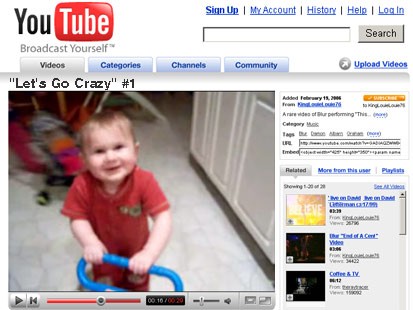
The LA Times reports that Stephanie Lenz, a mother who posted a clip of her baby dancing to the artist formerly known as the artist formerly known as Prince's song, 'Let's Go Crazy' has won the first stage of her battle against Universal Music (see earlier IPKat post here). Ms Lenz's clip was removed from YouTube after the site received a takedown notice under the Digital Millennium Copyright Act from Universal, the holder of the copyright in the song. The clip was reinstated after a month, but Lenz sued under the DMCA, pointing to the requirement therein that copyright owners can only demand the taking down of a work if they have "a good faith belief that use of the material in the manner complained of is not authorized by the copyright owner, its agent, or the law."

Universal argued that copyright holders, in making this assessment, did not need to take into account whether the use made by the subject of the notice was fair use, since fair use is a defence, rather than a legal right. Not so, according to Judge Jeremy Fogel, who states:
"Even if Universal is correct that fair use only excuses infringement, the fact remains that fair use is a lawful use of a copyright. Accordingly, in order for a copyright owner to proceed under the DMCA with “a good-faith belief that use of the material in the manner complained of is not authorized by the copyright owner, its agent or the law,” the owner must evaluate whether the material makes fair use of the copyright. 17 U.S.C. § 512(c)(3)(A)(v)."
However, he went on the conclude that Lenz was unlikely to win the case at full trial as she would need to show subjective bad faith on the part of Universal, i.e. that when it issued the takedown notice, it knew it was making a groundless threat of infringement.

The LA Times observes that the need to evaluate fair use will make it difficult for copyright owners to use automated 'bots to root out works which borrow from copyright works and issue take down notices ('bots can't evaluate whether use is fair).

The IPKat reckons that this is a good decision. On the whole, copyright owners are likely to be in a better position to evaluate fair use than individuals who post materials, and hosting sites, if forced to evaluate fair use may take a risk-averse strategy that would prevent them from allowing many socially useful works. The IPKat reckons that unless copyright owners are forced to evaluate fair use, many works which constitute fair uses will just disappear if made the subject of take-down notices since only exceptional individuals like Ms Lenz will persevere in getting their work reinstated.

Wednesday, 9 July 2008

Did MEPs vote to cut off copyright infringers' internet?

The Registry reports that Members of the European Parlioament (MEPs) may have accidentally included measures forcing ISPs to cut off internet access for those who infringe copyright through dowloading. The test calls for "cooperation" between ISPs and those "interested in the protection and promotion of lawful content". The trouble is, no one quite knows what "cooperation" means, including Malcolm Harbor, one of the MEPs responsible for the text. Today he said

"The interpretation ... is alarmist and scare-mongering and deflects from the intention which was to improve consumers' rights".
He has also promised to amend the text if it causes confusion.

The IPKat reckons that such vague language is an attempt to make everyone happy, which ultimately means that it will make no one happy. He also notes that it's not that hard to get and internet package and reckons that hardcore downloaders can probably find ways to get internet access, even if their original ISP cuts them off.

Monday, 14 April 2008

Last week in the European Parliament...

ZDNet reports that the European Parliament has approved two reports on the cultural industries which cast doubts on combating copyright infringement through cutting off offenders’ internet access.

A visit to the European Parliament’s website doesn’t make things much clearer.

One report calls for greater support for industries such as publishing and the music industry which are threatened by piracy.

In another report, French Socialist Guy Bono notes

“Criminalising consumers who are not seeking to make a profit is not the right solution to combat digital piracy…The central message of this report is to find a balance between the possibility to access cultural events and content while ensuring cultural diversity and genuine income to the right holders,"

Also discussed last week, and of interest to IP lawyers, was a European heritage label for goods, memorials and monuments to combat the “threat” of the globalisation of culture.

The IPKat reckons that rather than this being a contradiction, perhaps the EP is getting this right. There is a need to protect copyright owners, but not in a way that is disproportionate to the interests of the rest of society.

Tuesday, 25 March 2008

Virtual reality

The avatars fight back

The IPKat took a trip into a parallel universe with a visit to the Seventh Sun, which reports on a new campaign by a group of Second Life Avatars to raise awareness of the ‘theft’ of virtual items created by the avatars (or at least, their creators) and imported into Second Life, where they are sold. The campaign features various seemingly well know avatars au naturel with the slogan ‘Content theft steals the clothes off our backs’.

What stands out to the IPKat is that although the ‘theft’ is of computer code, the rhetoric sounds like it comes straight from the tangible world. According to the avatars, what is being stolen is ‘stuff’ – even though it’s electronic, it does represent clothes, jewellery etc. According to one avatar, who owns a Second Life clothing store: ‘We want residents to understand that, for many content creators, SL is their livelihood and theft here is no different from theft in the real world. Intellectual property theft is illegal and actionable in courts around the world regardless of whether it happens in real life or inside a ‘game.’


World IP Day is on the way

It’s just over a month to go until World Intellectual Property Day (26 April 2008). This year’s theme according to WIPO is ‘celebrating innovation and promoting respect for intellectual property’. The IPKat is puzzled. Celebrating innovation he can understand, but what does promoting respect for IP mean? He thought perhaps that this was politically correct speak for stronger enforcement mechanisms, but then he read WIPO DG Kamil Idris’s message for World IP Day. He rounds off by stating:
"And so, on World Intellectual Property Day, we pay tribute to the inventors and artists, great and small, who enrich our existence with the fruits of their innovative thoughts and creative vision. And we remember why it is that their intellectual property rights, the rights that they have earned through their individual and collective talents, deserve our admiration, our protection, and our respect".
It seems then that protecting IP is different from respecting it. What does respect mean then? Should the IPKat doff his cap each time an inventor walks past?

Monday, 17 March 2008

Japanese ISPs to take on downloaders

The IPKat has learnt from ZDNet that ISPs and copyright holders in Japan have reached an agreement by which Japan’s largest four ISPs will ban flagrant copyright infringers. Copyright owners will peruse lists of IP addresses downloading their works, and will then send that lists to the ISPs, who will warn the owners of the IP addresses and, if their behaviour doesn’t change, ban them. ZDNet claims there would be no privacy concerns because copyright owners would only need to look out for their own copyright works.

The IPKat says make no mistake, file sharing of copyright works is very naughty. However, he finds the idea of an agreement on withdrawing internet services stitched up between copyright owners and ISPs rather worrying. Surely it’s for copyright holders to enforce their own copyright and for ISPs to provide internet service unless their under a legal requirement to act as a police force as well?

Monday, 28 January 2008

Lawyer asserts copyright in cease and desist letter

The IPKat has learnt from Slashdot that a lawyer in the US has managed to win a copyright case against a website which posted a cease and desist letter that he sent.

The case is somewhat of an oddity, as rather than being a staightforward infringement case, it is a case under the DMCA in which an ISP was asked to identify an alleged infringer, and so the would-be copyright owning lawyer only had to show prima facie evidence of infringement. The court mentioned, but declined to rule on, whether the letter has the modicum of creativity that is required to qualify it for protection under copyright law. Instead it found that the fact that the lawyer had a certificate of copyright registration was prima facie evidence of eligibility for copyright protection. The entire letter was published online, so there was no problem with showing that an original part of the work was published.

The IPKat notes that this could deprive the 'little guys' of the ability to engage in self-help, and he wonders if it's a bit of an own-goal for a lawyer to show that he's ashamed of what he has written by using copyright law to limit its dissemination. He notes though that in the UK we have actions for unjustified threats of infringement which may protect the 'little guys'.

Extracts from the case here.

Thursday, 24 January 2008

Independence - will US say ICANN can?


ICANN, the body responsible for overseeing the domain name system has written to the US Government asking for its independence according to the BBC. The organisation was set up under a Memorandum of Understanding with the US Department of Commerce, with eventual aim being to shift the domain name system from US Government control to global control. The memorandum set out a task of objectives for ICANN to achieve, after which it would become independent. ICANN argues that those objectives have been achieved early, and so now is the time to decide on the future of ICANN.

The IPKat finds this a tricky one. In an ideal world, a worldwide system should be run by a public body which is worldwide, but the bureaucracy that would create would most likely be startling.

Wednesday, 23 January 2008

EU on term extention for sound recordings


The IPKat has learnt from a combination of Boing Boing and Slashdot that the EU appears to have ditched plans to extend the term of sound recordings, and also to require ISPs to filter content.

The website of the CULT committee (don't get too excited - CULT stands for Culture and Education, rather than anything more sinister) did not have the latest set of minutes, recording this decision.

Can any of the IPKat's readers offer any further information?

Wednesday, 16 January 2008

Scrabble scramble


New.com.au reports that Hasbro and Mattel are trying to shut down Scrabulous, an online version of their Scrabble game, which is available through Facebook. There is currently no authorised electronic version of Scrabble, but Electronic Arts is developing one under licence.

The IPKat says that infringing other people’s IP rights is never a good idea, and the fact that you’re doing it online doesn’t magically make it OK. In the ideal world of pragamtic utopia, Hasbro would make both itself and its fans happy and take over the existing version, though that wouldn’t be possible on the assumption that Hasbro has granted Electronic Arts an exclusive licence.

Followers