Search

Showing posts with label france. Show all posts

Thursday, 7 October 2010

Céline, c'est la vie -- mais ce n'est pas le fin

Céline, with the accent ...
In the dim and distant past, when dinosaurs ruled the world ... well, this may be a slight exaggeration but we're talking about September 2007, a long time ago in Kat's years, the Court of Justice of the European Communities (as it was then called) gave a fairly unspectacular ruling in Case C-17/06 Céline SARL v Céline SA. The court's ruling was prompted by a reference for a preliminary ruling from the Cour d'appel de Nancy, France and arose from a dispute between two businesses, each of which claimed an entitlement to the word Céline: the claimant, which had a registered trade mark CELINE, sought to prevent the defendant appropriating Céline as a company name and shop name. The Court ruled as follows:
""The unauthorised use by a third party of a company name, trade name or shop name which is identical to an earlier mark in connection with the marketing of goods which are identical to those in relation to which that mark was registered constitutes use which the proprietor of that mark is entitled to prevent in accordance with Article 5(1)(a) of ... Council Directive 89/104, where the use is in relation to goods in such a way as to affect or to be liable to affect the functions of the mark.

Should that be the case, Article 6(1)(a) [of the same Directive] can operate as a bar to such use being prevented only if the use by the third party of his company name or trade name is in accordance with honest practices in industrial or commercial matters".
Fast-forward to April 2010 and we have the ruling of the Cour d'appel de Nancy, helpfully summarised in volume 65, no.17 of the INTA Bulletin (released 1 October 2010).  This summary, by IP enthusiasts Franck Soutoul and Jean-Philippe Bresson of Inlex IP Expertise, reads in relevant part as follows (nb items such as this do not appear in the INTA Bulletin unless they have been independently verified, which makes them commendably reliable):
"The French court held that the functions of the earlier trademark had been affected. Evidence showed that labels with CELINE were affixed to the goods sold in the shop. The court said that, as the goods were identical and the trademark CELINE was well known, the public would wrongly conclude that all the goods had the same origin. This constituted trademark infringement under Article 5(1)(a) ...

However, when addressing the defense’s fair use arguments, the French court distinguished between the trade name and the shop name ... and the context behind the company name ....
Céline SARL had used CELINE as a trade name and as a shop name in good faith because the name was adopted two years after the registration of the plaintiff’s trademark and at a time when that trademark had no particular reputation.

However, the choice of CELINE as a company name in 1992 was regarded as resulting from bad faith, considering the success and reputation that Céline SA had then obtained both nationally and internationally under its trademark and given that Céline SA had, before the adoption, demanded that the other company not use CELINE as a company name.

While following the ECJ ruling, the decision of the French court was quite unusual in the end. The court ordered that Céline SARL stop “any” use of the name CELINE (including as a trade name or shop name). However, this position does not make sense given the finding that the trade name and shop name were adopted in good faith. This might be grounds for an appeal to the French High Court".
... and without
The IPKat has observed that sometimes a court's judgment can make perfect sense in terms of the application of each of a set of rules to a set of facts, yet produce a result that can seem quite perplexing to traders or consumers.  On other occasions it may make a ruling which makes good sense to traders or consumers but appears to violate the text or purport of the laws.  We can't really decide whether our judiciary should serve a function which is (i) quasi-legislative in terms of how it shapes and develops statute law, (ii) purely interpretative or (iii) narrowly focused on giving words their literal meanings and applying them literally to the facts.  If one started with the facts of Céline and considered how best they should be resolved, rather than starting with the law and deciding on the outcome of its application to the Céline facts, would the two processes have a coterminous 'footprint'?

Merpel says, there's something very attractive and marketable about French forenames: Céline, Colette, Amélie, Capucine, Candide, Cher, Heloise, Michelle, Giselle, Babar ...

Tuesday, 16 February 2010

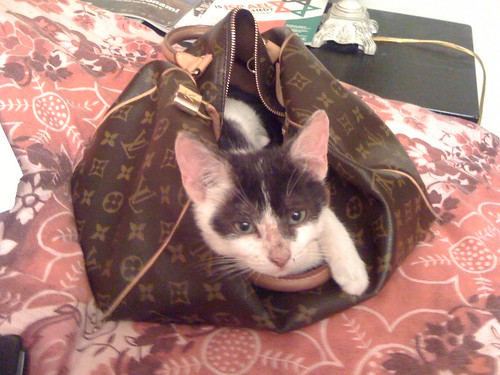
LVMH v eBay: it's in the bag!


The latest chapter of the “Brand Owners v Counterfeiters” saga seems again to be playing out in favour of brand owners, with last week’s decision of a Paris District Court holding eBay responsible for facilitating the sale of counterfeit Louis Vuitton products. In a guest post, the IPKat’s friend Venya Wijegoonewardene (Gallant Macmillan LLP) reports on the tail:
Last week a Paris court awarded Louis Vuitton Moet Hennessy (the parent company of the luxury handbag brand Louis Vuitton) €200,000 in damages and €30,000 in costs in their trade mark infringement claim against eBay. The internet giant was ordered to pay these damages to LVMH for “harming the reputation of Louis Vuitton trade marks, the company name and the domain name.” The dispute originated in 2006 when Louis Vuitton, in order to preserve its brands' luxury status, commenced proceedings against eBay for their purchasing of misspelled words similar to the Louis Vuitton mark from search engines such as Yahoo and Google.

Although it is accepted business practice for companies such as eBay to purchase search-related keywords, including misspelled terms, to direct web-traffic to their websites, the French court held that by purchasing misspelled terms such as “Louis Viton” and “Wuiton”, eBay enabled counterfeiters to flog their wares on eBay. eBay defended their position by stating that this was how the search system worked: it automatically purchased the misspelled words as commercial links, redirecting consumers to their website to purchase genuine Louis Vuitton goods.

Although the final award was substantially lower than the initial amount claimed by LVMH (a mere €1.2 million), the court was firm in placing the responsibility of the infringement squarely on the shoulders of eBay. The court also ordered that eBay would additionally have to pay a €1,000 penalty every time search-related keywords that “harmed the reputation of the Louis Vuitton brand” were used in the future.

LVMH is the world’s biggest luxury conglomerate and boasts some of the world’s biggest ‘snob-tags’ [attribution for that phrase goes to Lord Justice Jacob in his closing speech at the IBIL and OFT Seminar on Brand Protection and Competition], including Moet, Dom Perignon and Marc Jacobs. Vuitton’s continued triumph in the French courts will not come as a surprise. Brand owners like LVMH have resorted to the sympathetic French courts in the pursuit of controlling a brand’s image, reputation and status. A spokesperson for LVMH welcomed the move, stating that French ruling protects consumers from becoming a victim due to the “illicit use of trade marks”. However, the extent to which such actions are really in the interest of the consumer has been questioned. These actions may be viewed as efforts by brand owners, such as LVMH, to preserve the elitist ‘snob-status’ of the luxury brand. For example, whether the discerning Louis Vuitton consumer would shop for the signature monogrammed handbag on eBay with the availability of genuine brands on high-end websites such as www.outnet.com is open to doubt.

Yohan Ruso, managing director of eBay France, accused LVMH of wanting to “tarnish the image of eBay” and cited the fine as being “totally disproportionate” [Good for you, eBay – you're also a brand owner and there is no reason why luxury brands should monopolise the use of the “brand status” argument]. According to this report from Reuters, the eBay statement declared that “this issue is being used by certain rights owners as an excuse to retain total control of what people can buy, where they can buy it from and how much they have to pay," Ebay said in a statement.” They stated that the judgment “flies in the face” of a recent Belgian victory in eBay’s favour [do any IPKat readers have a copy of this decision?].

This decision has expectedly tipped the scales in favour of brand-owners. But with eBay ever-ready for the fight, this battle is far from finished".
The IPKat suggests readers once again peruse the 2006 French decision that deemed Google to have infringed Louis Vuitton’s trade marks by selling search-related keywords (reported by the IPKat here). Google was ordered to pay €300,000 in damages for trade mark counterfeiting in that case. This past September, LVMH also secured a $32.4 million judgment in their favour against an ISP in California for contributory trade mark infringement in the selling of counterfeit products (see this AmeriKat post). So perhaps the French courts are not the only favourable forum for luxury brand owners ...

Thursday, 8 October 2009

Small, convivial messages: how the French send their textos

The IPKat has heard from his friend Jean-Philippe Bresson (Inlex) that registration of the French trade mark TEXTO, for services in Class 38, has been cancelled following a decision last month of the Cour d'appel de Paris.

The TEXTO mark, owned by French phone operator SFR, was originally filed in 2001 for “services of written messages for radio-phones” -- which sounds a bit like text messages, doesn't it? SFR actually commenced the sequence of events leading to the demise of its mark when it sued another French company, ONE TEXTO, which was incorporated for the purposes of “communication, marketing, advertising, mobile telephony, SMS for business and management and for robotic and hi-tech fields”. ONE TEXTO also filed its name as a trade mark in 2003 in services in classes 35, 38 and 42, apart from owning the onetexto.com domain name.

ONE TEXTO in turn sought the cancellation of the earlier trade mark for descriptiveness. Several publications and articles were submitted as evidence in order to demonstrate that “TEXTO” was known by the public as the name of "a small written and convivial message sent by mobile phone" [Jean-Philippe's charming definition].

The Cour d'appel ruled that, at the time of filing of the mark “TEXTO”, that word was indeed usual for designating a message sent by phone and was not particularly associated with the plaintiff. Being a usual designation of a service in the current language, cancellation of the mark was thus upheld by the court. Comments Jean-Philippe: "
We remain a bit surprised that SFR refrained from arguing that the mark TEXTO had acquired a distinctive character through long and intensive use. But the matter is strategically interesting for any company operating in relation to telephone communication services/activities but also while considering suing a competitor on the basis of a mark which distinctiveness is likely to be discussed".
Feed your cat via text message here
How to make a cat in a text message format here

Wednesday, 10 June 2009

Loi Hadopi falls at the last hurdle

Fresh from Guardian online is news that the controversial French loi Hadopi (the "three strikes and you're out" approach to dealing with unlawful file-sharers and internet-enabled copyright infringers) has been struck down by the Constitutional Council as being unconstitutional. According to Richard Wray ("French anti-filesharing law overturned"):
"The French judiciary has ridden to the rescue of the country's web users, striking down a controversial new law which would have allowed the state to cut off the internet connections of illegal filesharers for up to a year.

The ruling is a blow to French president Nicolas Sarkozy, who had characterised the so-called "three strikes" law as a crucial weapon in the fight against online piracy. ... France's constitutional council ruled today that "free access" to online communications services is a human right and cannot be withheld without a judge's intervention. The council also ruled that the method of policing the web envisaged in the law breaches a citizen's right to privacy.

... Under the French law, which was passed last month after initial resistance from politicians, persistent illegal filesharers were to be warned by email and then letter that they should stop sharing copyrighted material. If they continued, their internet connection could be cut off for up to a year.

... The French ruling, which comes after the country's Socialist party asked the council to look at the legality of the Hadopi law, is unlikely to have a direct impact on the legality of any UK moves to combat piracy by using technical measures because it is based on a reading of the French constitution, rather than EU law".
The IPKat suspects that this will not be an end to the matter, and awaits further developments (possibly from the European Commission in Brussels) with interest.

See also note and further materials here

Monday, 23 March 2009

French patent information - gratuit!


The IPKat has recently noticed, via Laurent Teyssedre's excellent blog du droit europeen des brevets, that the French patent office (commonly known as INPI) has announced that as from 3 April 2009 all sorts of useful patent information will be available online, apparently for free.  INPI say:
"A partir du 3 avril 2009, le nouveau service de recherche de l'INPI sur le statut légal des brevets vous permettra d'accéder gratuitement aux informations légales des demandes de brevets français et européens délivrés, désignant la France. Il s'agit d'une première version qui sera enrichie au cours du second semestre 2009.
Ce service vient compléter fr.espacenet.com qui donne déjà un accès libre et gratuit à plus de 4 millions de demandes de brevets français, européens et internationaux PCT publiées depuis 1978"
The IPKat, who has found it a little frustrating (not to say expensive) to find French patent status information, unlike information available from the UK and German offices here and here, is very much looking forward to making use of this new service. 

Merpel wonders whether the service will be available with an English user interface. Don't be silly, says Tufty, that would be making things too easy.

Tuesday, 17 March 2009

AdWords and keywords everywhere

AdWord decisions are everywhere these days... or so it seems. The IPKat has news from the European Court of Justice's (ECJ) hearing in the Google France v. Louis Vuitton Malletier case (C- 236/08) and an update on the German Federal Supreme Court's recent AdWord decisions.


Bloomberg's Stephanie Bodoni, who is an old friend of the IPKat, reports of the ECJ's hearing in Google France v. Louis Vuitton Malletier (C- 236/08), one of the three joined cases C-236/08, C-237/08, C-238/08 which the French Cour de Cassation had referred to the ECJ for preliminary rulings (see the IPKat's post here). The ongoing dispute between Google France and Louis Vuitton Malletier (LVMH) centres around the use of keyword (AdWord) advertising and Internet searches that display sponsored links that refer users to sites selling rival products and even counterfeits.

Arguments brought forward by Google's lawyer, Alexandra Neri, include:
  • “Google makes money not by reason of the nature of the keyword, but by someone clicking on the keyword.”
  • “The decision to click or not to click belongs to who -- clearly to the Internet user.”
  • In Bloomberg's report Ms. Neri is further cited as telling the court that 'Keywords aren’t visible and therefore can’t be considered a protected trademark', [the IPKat wonders whether this is really what Ms. Neri said].
  • Google “doesn’t seek to play policeman to control what the advertisers do”. Ms Neri is further cited as saying that when Google’s French unit received proof of a registered trade mark from a company, it would add the same to a database in order to have it blocked from being chosen as a keyword.
Arguments brought forward by LVMH's lawyer, Patrice de Cande, include:
  • “Google’s advertisement activities have given companies which sell fake products unprecedented visibility beyond their wildest dreams.”
  • In Bloomberg's report Mr. de Cande is cited as telling the court that Google had not acted quickly enough when it received Louis Vuitton’s complaint and that it did not change its system.
  • Mr. de Cande is further cited as saying that Google was perfectly capable to block such infringing use “but it won’t do so until it is legally required to do so”.
As a much wiser Kat has said before, the Court's ruling will be one of the most commercially sensitive it has ever faced because it can make or break the keywords industry in Europe.

For further information on the French Cour de Cassation's referral to the ECJ, please see French blogger extraordinaire Frédéric Glaize's posts on the Class 46 weblog here, here and here.


In the meantime, the German Federal Supreme Court (Bundesgerichtshof) has published the full text of its AdWord decisions in the the Beta Layout and pcb cases (Beta Layout, I ZR 30/07 and pbc, I ZR 139/07; see the IPKat's earlier post here). As with the Bundesgerichtshof's ECJ referral in the bananabay case (I ZR 125/07), this Kat tried again to translate the court's headnotes. Additions in [square red brackets] have been added by the IPKat in an attempt to make the headnotes easier to digest.

Beta Layout (I ZR 30/07)

The IPKat's translation attempt:

If a term, which is consistent with third party's company name(Unternehmenskennzeichen), is booked as a so-called keyword with an Internet search engine, then a likelihood of confusion between the keyword and the protected sign can be denied, in cases where the term is entered [as a search term in the search engine] by an Internet user if an advertisement of the party that had booked the keyword is subsequently displayed on an Internet site, next to and to the right of the [actual] results list under the heading "Advertisements" - provided that the advertisement itself does not use the protected sign.

The Bundesgerichtshof's German headnote:

"Wird ein mit einem fremden Unternehmenskennzeichen übereinstimmender Begriff bei einer Internetsuchmaschine als sogenanntes Schlüsselwort (Keyword) angemeldet, so kann eine Verwechslungsgefahr zwischen dem Schlüsselwort und dem geschützten Kennzeichen zu verneinen sein, wenn bei Eingabe des Begriffs durch einen Internetnutzer auf der dann erscheinenden Internetseite rechts neben der Trefferliste unter einer Rubrik mit der Überschrift „Anzeigen" eine Werbeanzeige des Anmelders des Schlüsselworts eingeblendet wird, in der das geschützte Zeichen selbst nicht verwendet wird."

* Full text available here (in German)


pcb (I ZR 139/07)

The IPKat's translation attempt:

If a term, which the relevant trade circles will interpret as descriptive information about the characteristics and features of goods (here: "pcb" als short for "printed circuit board"), is booked as a so-called keyword with a search engine, then use [of this term] might not constitute use a trade sign/trade mark, where this term is protected as a trade mark (here: "pcb-pool") and is entered by an Internet user [as a search term in the search engine], if an advertisement of the party that had booked the keyword is subsequently displayed on an Internet site, next to and to the right side of the [actual] results list under the heading "Advertisements" - provided that the advertisement itself does not use the protected sign.


The Bundesgerichtshof's German headnote:

"Wird bei einer Internetsuchmaschine eine Bezeichnung, die von den angesprochenen Verkehrskreisen als eine beschreibende Angabe über Merkmale undEigenschaften von Waren verstanden wird (hier: „pcb" als Abkürzung von „printed circuit board"), als sogenanntes Schlüsselwort (Keyword) angemeldet, ist eine kennzeichenmäßige Verwendung zu verneinen, wenn bei Eingabe einer als Marke geschützten Bezeichnung durch einen Internetnutzer (hier: „pcb-pool") auf der dann erscheinenden Internetseite rechts neben der Trefferliste unter einer Rubrik mit der Überschrift „Anzeigen" eine Werbeanzeige des Anmelders des Schlüsselworts eingeblendet wird, in der das geschützte Zeichen selbst nicht verwendet wird."

*Full text available here (in German)

If any of our readers have alternative and more elegant translations, then the IPKat would love to hear from them.

Thursday, 26 February 2009

Copyright alive and kicking: MGMT v Sarkozy's UMP, Annie Leibovitz 'pawns' her copyrights

The IPKat has come across two news items concerning copyright matters. The Guardian reports that French president Sarkozy's UMP party (Union pour un Mouvement Populaire) is to compensate indie group MGMT for using their song 'Kids' at recent party rallies without seeking the band's permission. According to the news report the song was played at UMP party meetings on 24 and 25 January 2009 and was also used for official videos displayed on the UMP website. 'It seems that those who led the charge against internet users are not the most respectful of copyright', the band's French lawyer Isabelle Wekstein is cited in the Guardian.

According to a report by AFP, UMP's public relations firm has now confirmed the use of the song but insists that it was 'an unintentional mistake'. The UMP has offered the band one (1) Euro in symbolic damages for copyright infringement. AFP further reports that MGMT's lawyer has already rejected the offer as 'disrespectful of the rights of artists and authors' and 'insulting' and has demanded full financial compensation. According to Ms. Wekstein, the UMP has only paid a standard 53 Euro fee to SACEM, the French music licensing body, which did not cover subsequent uses of the song, particularly on the internet.

The timing of this copyright controversy is not devoid of a certain irony given that the new French anti-file sharing law is due to be presented to the French national assembly in about a week's time. Even more so because of the UMP's strict stance in France's debate over file sharing and online piracy. The UMP has repeatedly demanded stricter laws against those who infringe on musicians' copyright.

Et voilà .... thinks Merpel, while the IPKat says merci to his friend and famous blogger Frédéric Glaize for alerting the Kat to the UMP's 'symbolic' compensation offer.

In other copyright related news famous photographer Annie Leibovitz (shown left) has reportedly 'pawned' the rights to her life's work in order to borrow £10.8m from Art Capital Group, a Manhattan lender, to pay off debts. The Telegraph reports that Ms. Leibovitz secured the loan partly against copyrights and contract rights to 'every photograph she has ever taken or will take in future as collateral'.
The Telegraph explains that in the current economic climate more and more wealthy US art collectors are turning to their art collections to raise capital. Art lenders appear to work 'like a high class pawnshop' by lending up to 40 per cent of the work's worth, and taking possession of the actual work.


More information on France's proposed new law can be found here (in French) and here (in English)
More information on Annie Leibovitz can be found here.

Wednesday, 5 November 2008

"Off with their Nets!"

From the IPKat's friend Hugo Cox comes this link to the current French internet law initiative regarding serial downloaders. The position is that the French Senate has overwhelmingly voted to support a law that would cut off internet access to surfers who repeatedly download copyright music, films or video games without paying. The "graduated response" (that's the polite term for "three strikes and you're out") legislation will provide that illegal downloaders first get an email warning them of their infraction; next they get a warning letter in the post. Finally their internet connection will be severed for a full year.

Right: the French have a simple but effective way to keep serial downloaders offline -- and by the end of the year they hope to have perfected a technique for reconnection ...

Massively popular, this measure was passed by 297 votes to 15 -- but it is not as popular with the European Parliament as it is with the French, since in September the European Parliament voted heavily in favour of outlawing cut-off.

Wednesday, 2 July 2008

eBay loses another French trade mark case

The IPKat has been a little slow in reporting on Monday's decision of the Paris Commercial Court to order eBay to pay 40 million euros to Louis Vuitton, Christian Dior Couture and various perfume brands owned by the LVMH group (see the Times article here). The main reason appears to be damage to the reputation of the various trade marks caused by the sale of counterfeit products. The court pointed to 'serious faults' in the way eBay ran the site. eBay has said it will appeal.

The dispute concerning the perfumes was somewhat different as there the argument was that eBay shouldn't allow genuine products to be sold on its sites because this would interfere with LVMH's exclusive distribution network.

The IPKat would dearly love to know how the sums for the damages were calculated. Surely there aren't so many people in France who would have bought a genuine Louis Vuitton bag but decided not to because of the eBay alternative? If the damage was for harm to Louis Vuitton's reputation, does this mean that the French court has stumbled on the secret for calculating how much damage harming a mark's exclusivity does? As for the the perfumes, the IPKat is scratching his head as to how this accords with the rules of exhaustion of rights (assuming that is that the eBay perfume originates in the EU).

Thursday, 5 June 2008

eBay loses French trade mark case

The IPKat has learnt from AFP that a French court has ruled that eBay must pay Hermes 20,000 euros for allowing counterfeit Hermes bags on its site. The court found that

“By selling Hermes bags and branded accessories on the eBay.fr site, and by failing to act within their powers to prevent reprehensible use of the site… [both eBay and the seller] committed acts of counterfeiting and imitation of French brand names ... to the detriment of Hermes international."

eBay must also publish the ruling on its homepage.

Counsel for Hermes argued that eBay was more than a mere passive intermediary, instead:

"eBay is an active player in the transaction because not only does it offer a number of services to improve the sale, but when it does not work well enough or fast enough, they intervene with the client…They are perfectly informed of the transactions since they take a percentage cut."

The IPKat isn’t sure about this ruling. He doubts whether someone at eBay really has knowledge of every transaction that is taking place. He reckons that forcing someone to check out if each branded item sold is real of counterfeit would make the business model untenable, which would remove a valuable service for consumers. Merpel comment, 20,000 euros for damage to a luxury brand – that's not a lot, is it?

Tuesday, 3 June 2008

French court in the act?


A new case appears on the ECJ website. It appears to be an infraction case and, since France is being infracted, it is perhaps fitting that the case is only available in French. The IPKat's rudimentary French causes him to believe that France is being rapped over the knuckles for failing to communicate a list of Community design courts to the Commission. The ECJ concludes:

1) En l’absence de communication des tribunaux des dessins ou modèles communautaires à la Commission des Communautés européennes, la République française à manqué aux obligations qui lui incombent en vertu de l’article 80, paragraphe 2, du règlement (CE) nº 6/2002 du Conseil, du 12 décembre 2001, sur les dessins ou modèles communautaires.

2) La République française est condamnée aux dépens.

The IPKat would appreciate the assistance of any reader with a better grasp of French than his own.

Monday, 21 April 2008

French patent attorneys: an endangered species?

The IPKat would like to hand over this post to Alex Thurgood, an English patent professional living and working in France. Alex has some very interesting things to say about what is currently going on in the IP profession over there. The following is written in Alex’s own words (only mildly edited by the IPKat):

Just in case you weren't aware, there is a bit of a war of words going on over here in France at the moment, in relation to the potential future merger/acquisition of the French Bar with the IP attorney profession. Things are heating up now that the French Bar Association has made its position clear, which is that they will allow those who are already registered IP attorneys to join, but not all those wannabe's (i.e. our hardworking engineering and scientifically qualified juniors), who are going to have to sit the same qualifying exams as any normal wannabe barrister, in addition to the exams patent attorneys have to pass.

Ooops, there goes the patent attorney profession !!!

What this means is that a freshly qualified engineering graduate or PhD student will, if he is fortunate enough to find someone willing to take him on and train him, have to jump through rings, hoops, nay fire, for at least 6 years before being able to have a hope of calling him/herself an Avocat spécialisé en propriété intellectuelle (even the name may change apparently). The candidate will have to sit :
  • CEIPI 1 (IP Law) - similar in substance to the PG courses offered by Bournemouth or Queen Mary's from what I can judge
  • CEIPI 2 (French law of obligations, tort, ethics, constitutional law, community law, etc,etc)
  • pre-CAPA - I have no idea as yet what exactly this will consist of, although it is supposed to be the equivalent of CEIPI 1 and 2
  • the EQE (yes, obligatory, otherwise the candidate will be doomed to failure and wandering in the wilderness)
  • CAPA : bar exam, where IP will be but one option among the 20 or so subjects that are tested.
Bearing in mind that candidate are only allowed to sit the CAPA twice, ever.

In essence, the new system, if it were to go through, would require engineering or scientific based candidates to have the same knowledge as someone who has spent 6 years in law school, with a pass rate at the final exam of about 1 in 20.

Needless to say, which right minded trainee would want to go through all that, when they could just go and study law for 6 years instead ?

Where will we get our engineers from ?

The Bureau of the CNCPI, in its thirst for acceptance of the proposal, has been brandishing the spectre of deregulation, which will come anyway at some stage, and has now initiated a huge "win 'em over" campaign, blogs, stock and barrel. What the bureau fails to have seen is that, despite the mandate they were given at the AGM by the "majority" (I use that term lightly) of CPIs, they have not followed that mandate and appear on the face of it to have accepted what is totally unacceptable for many today, and especially for those who officially have no voice within the CNCPI: the trainees !!!

If you are an adept reader of French, then you may wish to peruse the CNCPI blog, which it has to be said, is illustrative of the lack of freedom given to its members, other than commenting on the crass contributions made by the moderator of the blog, an unknown, and non practising Doctor at Law, rather more versed apparently in constitutional law than anything to do with IP.

Another, more thought provoking blog is that of my erstwhile fellow Pierre Breesé.

It goes without saying that should we lose our identity in this big mess, then that'll mean more work for you guys [IPKat comment: i.e. patent attorneys outside France, and particularly those working in English], since French industry has already given this project the big thumbs down, and it will inevitably turn to IP service providers who are technically capable of understanding what it is they are trying to protect. Maybe you should start recruiting now ;-)

French industry has already said that it is largely against the merger, because inevitably the temptation will almost certainly be to align our prices with those of the barrister profession, and as a consequence many industry representatives, including the MEDEF (French equivalent to the CBI), have said that they will direct their IP work demands for day to day prosecution and filing to non-French firms, i.e. English and German firms essentially.

[In response to a question about whether this might mean the gradual death by retirement of the French IP profession:] As for growing old, we already have a problem, even without the future proposed integration. According to the statistics, roughly about one third of the French profession is due to retire over the next 10 years, and at present numbers of newly qualified entrants is well below the amount required to maintain the status quo. The whole of the French private practice IP industry only amounts to some 700 or so licensed professionals. If the merger goes through, then even fewer engineers will take the path to full qualification, and fewer still will pass, which as you surmise, will probably lead to the extinction of the patent attorney species as we know it in France. Certainly, in terms of client satisfaction, French industry is none too keen on the prospect of having to work with pure "lawyers" with no scientific background for the protection of its industrial innovation.

Although I was initially personally in favour of the merger, at the start the proposal involved maintaining our recognised specialised status and only having one extra adaptative exam for the new entrants (the grandfather clause would have existed for those already registered as IP attorneys), which in the end wouldn't have been too burdensome. The French Bar Association, however, has scuppered that intention because it felt that to allow anything else would be detrimental to its (rather poor IMO) public image and would be lowering its standards to accept the plebs (sorry for my somewhat ironical tone here) they call IP Attorneys (trademark and patent attorneys alike). They are also dead scared, for some obscure reason, that we are all suddenly going to compete with them for their client base!!! I must admit that I, and indeed the majority of my peers, have absolutely no intention of doing anything else in terms of legal services other than IP, and additionally, we are, as I said, only 700 or so, compared to 40,000 barristers nationwide. But this was not sufficient for the CNB, hence the draconian terms :-) There is even a plan by the CNB to make it illegal for European Patent Attorneys from practising independently, other than for filing and prosecution - no counselling though, in order to prevent groups of EPAs from forming independent companies and competing outside of the one big legal happy family we are all supposed to become.

There is a CNCPI AGM planned for May 13th, so we shall have to wait and see what kind of resolution is going to be put forward to us, but if we do decide to go ahead with the "collective suicide" then it is pretty clear that the face of IP representation in France as we know it, will change drastically. Oh, and as the proposal currently stands, if it goes through, we all have to become Avocat, it’s an all or nothing decision, there will be no possibility of remaining and IP Attorney on an individual basis, if you refuse, you will simply lose your current title and not be allowed to operate in France. And here was I thinking that lemmings lived in Scandinavia ?

I must admit as an Englishman in France, I would find this all quite amusing if I didn't have some heart for the youngsters that I'm training and are not yet qualified (aside from the extra financial burden that all of this will entail for the partners).

Alex summarises by suggesting that, if the proposal goes through, it will be a wonderful opportunity for other European patent firms to expand their horizons to the French client market. The IPKat tends to agree, as he can only see the French patent attorney profession gradually withering away through a combination of natural wastage, high prices, and a lack of new recruits if the merger goes ahead as planned.

Monday, 25 February 2008

French president calls for stronger protection for souffles


The Sydney Morning Herald reports that Monsieur le President is calling for French gastronomy to be added to the list set up by UNESCO’s Convention on the Protection and Promotion of the Diversity of Cultural Expressions. According to M. Sarkozy

"Agriculture and the professions which craft it every day are the source of our country's gastronomic diversity - it is an essential element of our heritage…That is why I want France to be the first country to apply to UNESCO, from 2009, for our gastronomic tradition to be recognised as a world heritage. We have the best gastronomy in the world."

A chef involved in the project, Guy Savoy added:

“You can talk about cuisine in numerous countries around the world …[but France] is the only one to have such diversity and such possibilities for transforming the produce of local artisans, be they on land or sea".

Mexico has already had a similar bid turned down. The verdict on France is expected in 2010.

The IPKat calls on Mr Brown to follow suit. Who knows when those nasty foreigners will take unfair advantage of Great Britain’s gastronomic treasures. The threat to the humble British black pudding should not be sniffed at. More seriously, the IPKat reckons that national cuisines have been exported outside their birthplaces so comprehensively that it’s rather difficult to work out what any country’s cuisine is anymore.

Wednesday, 16 January 2008

DSS have French patent revoked


The IPKat has just received a very helpful and friendly message from Otto Swens, a partner at Vondst Advocaten, about the latest episode in the ongoing DSS story. Regular IPKat readers will already be familiar with this company, which has been attempting to enforce their European patent relating to anti-forgery measures, and in particular against the European Central Bank, who DSS would argue are either already using or at least will want to use their patented technology in banknotes. The ECB has responded by attempting to have the patent revoked in each state in which it is in force. Otto takes up the story:

"On your website you posted various messages already [IPKat comment: here and here] on the action that the US company DSS filed at the European Court of First Instance against the European Central Bank for infringement of their European patent no. 0 455 750 with regard to the Euro banknotes. This action referred to 9 jurisdictions, namely Netherlands, Germany, UK, France, Italy, Belgium, Austria, Spain and Luxembourg. In response, the European Central Bank filed in March 2006 nullity actions against the relevant national parts of the European patent in suit in these nine jurisdictions claiming the patent to be invalid among others for added matter.

In this context, there is currently an interesting Europe-wide discussion on "added matter" ongoing. IP Kat already reported about this on 4 September 2007, indicating the German Court rejected the added matter argument by the ECB and ruled that the German part of the DSS patent was valid, whilst the UK High Court previously had accepted the same added matter argument and revoked the UK part of the DSS patent.

Now, there is a third decision available, namely the judgment of the Tribunal de Grande Instance in Paris of January 9, 2008 [available here] revoking the French part of the patent for added matter (cf. Pages 4 ff. of the attached English translation of the judgment, in particular page 12). Just like the UK Court [decision here], the Paris Court rejects DSS' main defence argument that claim 1 as granted would be disclosed in claim 13 of the application as originally filed. DSS had mainly relied on this claim which refers to copying an original document in a scanning copier. DSS argued that it disclosed the incorporation of the claimed security feature (overlay of a grid); in other words, DSS argued that by simply copying an original image with a copier, a "copy-protected document" would allegedly be created which includes an overlaid grid. The Paris Court rejected this approach. It held that the inventor had only disclosed a concept of rearranging lines of an artistic image but not the claimed overlay of a specific grid over the image lines. Interestingly, the French Court shortly addressed the ruling of the German Court on the parallel German patent and stated that the German judges erred in their construction of the original application, in particular of claim 13. Rather, the Paris Court followed the UK judgment to which it also explicitly referred. The French and UK judge apparently agree!"
A press release from DSS says that they will be appealing against this ruling. Putting his predicting hat on, the IPKat would hazard a guess that DSS now have a much slimmer chance of winning their fight to get large sums of money out of the ECB, now that they appear to have lost the fight (but not necessarily the whole battle, given the possibility of appeals) in both the UK and France. The words stone and blood come to mind, for some strange reason. One must, however, wait to see how the German court decides on the question of infringement, given that the EP(DE) patent has been found to be valid.

Friday, 7 December 2007

eBay France challenged

The IPKat has been a bit slack in failing to report that the French Council of Sales is taking eBay to court in France, arguing that it is failing to comply with a 2000 Act on the regulation of auctions. The Council is arguing that eBay has an unfair advantage over other auctioneers in failing to comply with the Act. As well as the potential for the sale of counterfeits, concerns have been raised regarding tax evasion by eBay users and fakes more generally, such as the user who want sent a photocopy of the picture he thought he had purchased, stuck to a block of wood. eBay counters that that it is not an auctioneer, and so does not fall within the scope of the Act since it only acts as an intermediary to put buyers and sellers in touch with each other.

The IPKat can sort of see the point of the unfair competition argument, if eBay really can be counted as an auction house, but wouldn’t it rather be the equivalent of the the classified pages at the back of a newspaper? However, he has a limited degree of sympathy for the consumers. Yes, they shouldn’t be duped, but they’re well aware of the limited safeguards that are available on a forum like eBay.

Followers